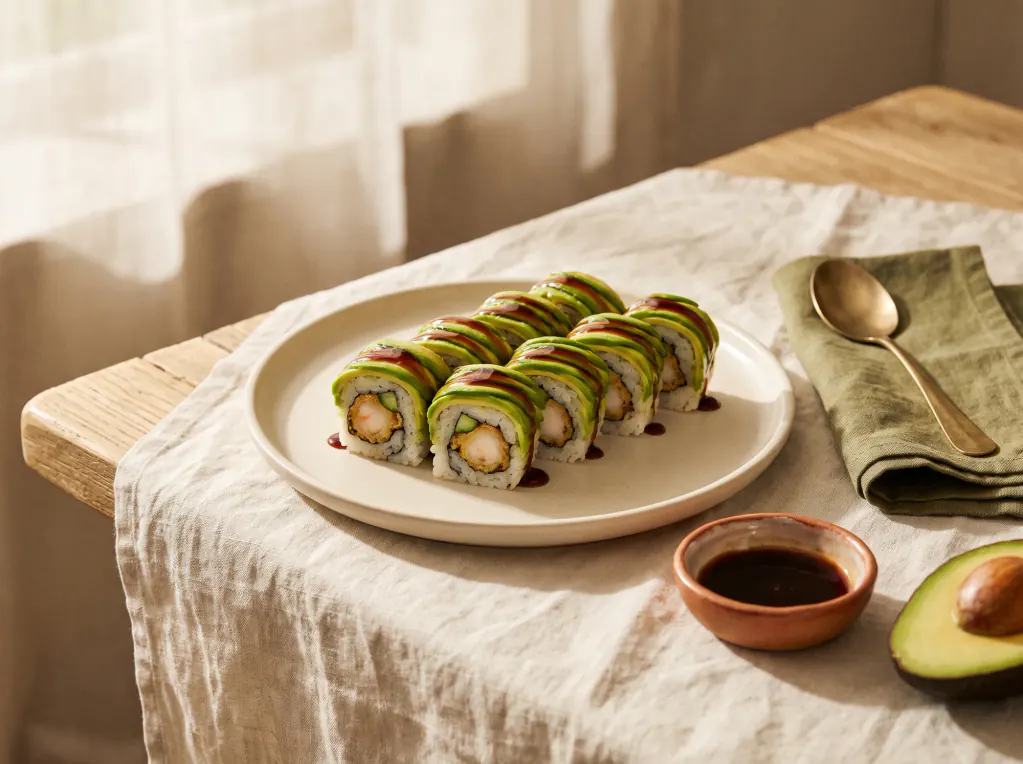
Philadelphia Rolls
A classic Philadelphia is built with lightly salted or cold-smoked salmon — that is how it was invented and how most places still serve it. This is not a safety compromise: salted fish holds its shape under the knife and does not bleed moisture into the rice the way raw fish does.

- Prep
- 40 min
- Total
- 40 min
- Servings
- 6
- Level
- Medium
- Per serving
- 330 kcal
Ingredients
-
What to use instead
Lightly salted trout works in place of salmon and is a little fattier and sweeter. Smoked mackerel works too, but it has a strong flavour of its own and buries the cheese.
Makes: 6 rolls of 8 pieces, 48 in all
Shopping list
The ingredients for the servings you chose — copy them or send them to a messenger. Tick what you already have at home: only the rest goes on the list.
Method
-
Step 1: Slice the fish and the cheese
Cut the salmon into thin 3 mm slices: some goes inside, some over the top of the roll. Cut the cream cheese into batons straight from the fridge — cold cheese cuts, room-temperature cheese smears along the knife.
-
Step 2: Wrap the mat
Cover the bamboo mat with two layers of cling film: the rice is on the outside here and will touch the mat across its whole surface. Put a bowl of water with a spoonful of vinegar beside you for your hands.
-
Step 3: Spread the rice and flip
Lay half a sheet of nori rough side up and, with a wet hand, spread 120 g of rice over the whole surface, right to the edges. Turn the sheet over carefully, rice underneath.
-
Step 4: Lay the filling
On the nori, towards your side, lay the batons of cream cheese, then strips of salmon and, if you like, the cucumber. One layer, no mound: an overfilled roll will not compress and splits where you cut it.
-
Step 5: Roll through the film
Lift the near edge of the mat along with the film, fold it over the filling and squeeze along the whole length. Draw the mat forward, roll to the end, then squeeze once more and straighten the sides.
-
Step 6: Lay salmon over the top
Lay slices of salmon overlapping along the whole roll, cover with film and go over it once more with the mat so the fish beds into the rice. This step is what makes it a Philadelphia rather than a roll with fish inside.
-
Step 7: Cut straight through the film
Leave the film on, wet a long sharp knife and cut the roll in half, drawing back then pushing forward. Put the halves side by side and cut each into four. Peel the film off the pieces afterwards — that way the fish on top stays where you put it.
Tips & variations
-
Tip
The cream cheese has to be cold and cut into batons, not spooned on. Soft cheese works its way out of the ends as you roll and glues the roll to the mat.
-
Variation
A baked Philadelphia is the same roll, spread with mayonnaise mixed with grated cheese and put under the grill for 5–7 minutes until the top colours. Cut it after baking, not before.
-
Swap
Lightly salted trout works in place of salmon and is a little fattier and sweeter. Smoked mackerel works too, but it has a strong flavour of its own and buries the cheese.
-
Storage
A roll with fish and cheese does not keep: the fish gives moisture up to the rice, and an hour in the fridge leaves it dense and dull. Roll as much as you are going to eat now.
-
Tip
If you do want raw fish, ordinary chilled salmon from the counter will not do. What makes it safe is freezing beforehand: −20 °C for seven days or −35 °C for fifteen hours, the FDA requirement for fish served raw. A household freezer holds −18 °C and does not meet it.
Nutrition
| 1 serving | Whole dish 6 servings | |
|---|---|---|
| Energy | 330 kcal | 1,980 kcal |
| Protein | 12 g | 72 g |
| Fat | 11 g | 66 g |
| Carbohydrates | 45 g | 270 g |
Approximate values calculated from standard ingredient data.
Cooked it? Rate the recipe
No ratings yet — yours will be the first.