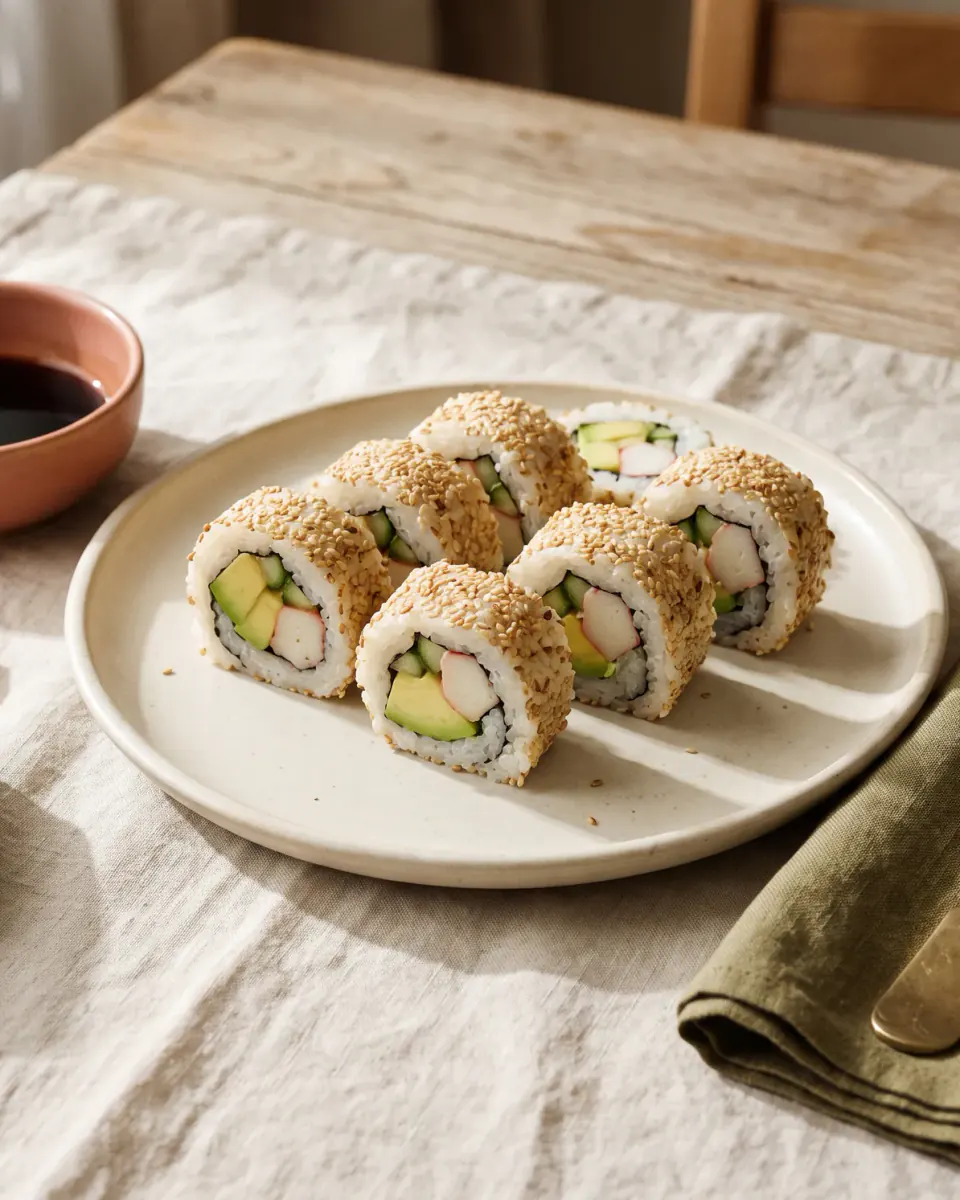
California Rolls
The California roll was invented for people put off by nori on the outside and by raw fish — which is exactly why it became the most popular roll in the world. The rice goes outside, the filling is cooked, and the only thing to learn is how to flip a sheet of rice without crushing it.
- Prep
- 40 min
- Total
- 40 min
- Servings
- 6
- Level
- Medium
- Per serving
- 280 kcal
Ingredients
-
What to use instead
Crab sticks are surimi, that is cooked white fish, and that is what most places build a California roll from. If you want real crab, use cooked meat; the flavour is finer and the price about five times higher.
Makes: 6 rolls of 8 pieces, 48 in all
Shopping list
The ingredients for the servings you chose — copy them or send them to a messenger. Tick what you already have at home: only the rest goes on the list.
Method
-
Step 1: Prepare the filling
Pull the crab sticks apart into strands with your fingers and mix them with the mayonnaise. Halve the cucumber lengthways, cut out the seeded core and cut it into 5 mm batons. Halve the avocado, remove the stone and cut 5 mm slices — firm avocado holds its shape, over-ripe smears itself across the rice.
-
Step 2: Wrap the mat
Cover the bamboo mat with two layers of cling film — rice on the outside means it touches the mat across its whole surface. Put a bowl of water with a spoonful of vinegar beside you for your hands.
-
Step 3: Spread the rice and flip
Lay half a sheet of nori rough side up. With a wet hand spread 120 g of rice over the whole surface, right to the edges, in an even layer. Scatter the sesame over it. Now turn the sheet over carefully — rice underneath, nori on top.
-
Step 4: Lay the filling
On the nori, towards your side, put a line of the crab mixture, then the cucumber and the avocado slices. Do not overfill: in an inside-out roll the filling has to sit in one layer, or the rice splits along the seams.
-
Step 5: Roll through the film
Lift the near edge of the mat along with the film and fold it over the filling, holding it in place with your fingers. Squeeze along the whole length, then draw the mat forward and roll on to the end. The film is what stops the rice sticking — which is why it is not optional here.
-
Step 6: Firm up the shape
With the mat still around it, squeeze the roll once more along its length and press the sides a little so it becomes an even cylinder. Five seconds of pressure is the difference between a roll and a heap of rice on a plate.
-
Step 7: Cut with a wet knife
Wet a long sharp knife and cut the roll in half, drawing back and then pushing forward. Put the halves side by side and cut each into four. Wet the blade before every cut — rice on the outside clings to a dry knife and comes away with it.
Tips & variations
-
Tip
The usual reason one fails is rice that was not spread right to the edges. In an inside-out roll it is those last centimetres that hold the seam; leave them bare and the roll opens the moment you cut it.
-
Variation
Instead of sesame the outside often gets flying-fish roe — masago or tobiko — which adds salt and a little crunch. It goes on the same way as the sesame: onto the rice, before you flip.
-
Swap
Crab sticks are surimi, that is cooked white fish, and that is what most places build a California roll from. If you want real crab, use cooked meat; the flavour is finer and the price about five times higher.
-
Storage
Avocado darkens within the hour, so California rolls are made just before serving. If you have to work ahead, sprinkle the slices with lemon juice and cover the rolls with a damp cloth — but not in the fridge.
-
Tip
The film on the mat has to be pulled tight, without creases. Every crease is a dent in the side of the roll, and it will not come out.
Nutrition
| 1 serving | Whole dish 6 servings | |
|---|---|---|
| Energy | 280 kcal | 1,680 kcal |
| Protein | 9 g | 54 g |
| Fat | 7 g | 42 g |
| Carbohydrates | 46 g | 276 g |
Approximate values calculated from standard ingredient data.
Cooked it? Rate the recipe
No ratings yet — yours will be the first.