Futomaki
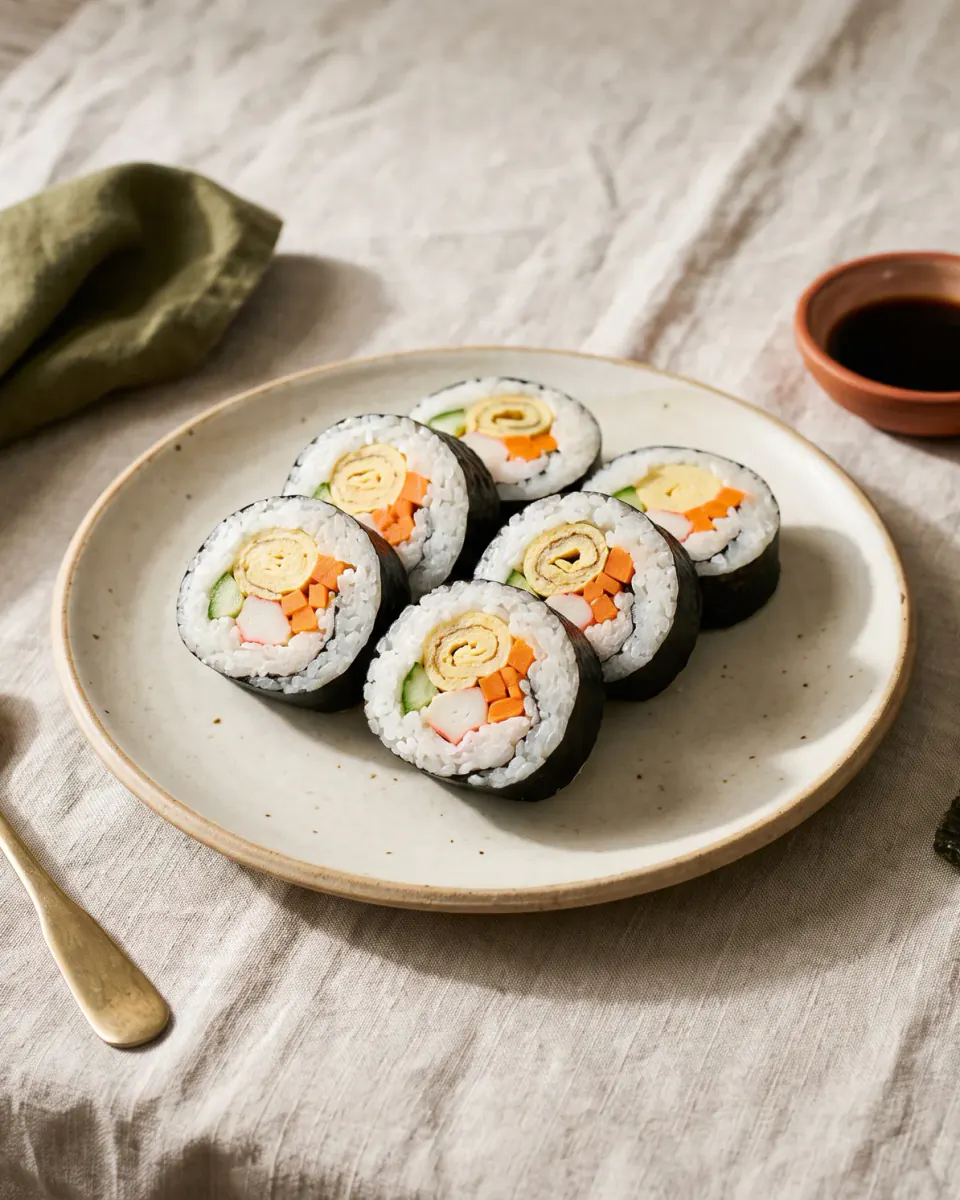
Futomaki is what Japan actually calls a sushi roll: a whole sheet of nori, 200 g of rice and four or five fillings laid in stripes so that the cut face makes a pattern. The difficulty lies exactly there — not in the rolling, but in keeping the fillings where you put them.
- Prep
- 45 min
- Cook
- 10 min
- Total
- 55 min
- Servings
- 4
- Level
- Challenging
- Per serving
- 420 kcal
Ingredients
-
What to use instead
A strip of fried tofu or avocado works well in place of crab sticks, which makes the futomaki fully vegetarian while the pattern on the cut face stays just as bright.
Makes: 4 rolls of 6 pieces, 24 in all
Shopping list
The ingredients for the servings you chose — copy them or send them to a messenger. Tick what you already have at home: only the rest goes on the list.
Method
-
Step 1: Get every filling ready
Cut the carrot into matchsticks and blanch for 2 minutes, scald the spinach and squeeze it dry, cut the cucumber into batons and the tamagoyaki into finger-thick strips. Futomaki is not a roll to improvise in: everything should be ready and roughly the same length.
-
Step 2: Spread rice on a whole sheet
Lay a whole sheet of nori on the mat, rough side up. With a wet hand spread 200 g of rice in an even layer, leaving 3 cm bare along the far edge — a thick roll needs a wider margin than a thin one.
-
Step 3: Lay the fillings in stripes
Arrange the fillings in parallel stripes a third of the way in from your side, tight against one another: tamagoyaki, carrot, cucumber, crab stick, spinach. There should be no gaps between them, because that is exactly where the roll breaks when it is cut.
-
Step 4: Press before the first turn
Hold the filling down with the fingers of both hands, pressing it into the rice, and only then start lifting the mat. This is the moment that decides it: if the filling shifts now, nothing later will straighten it.
-
Step 5: Roll and squeeze
Turn the edge of the nori over the filling so it lands immediately beyond it, draw the mat back and squeeze along the whole length. Roll to the end, then go over it with the mat again to even the shape.
-
Step 6: Let it rest
Leave the roll seam side down for 3–5 minutes. A thick roll needs longer for the nori to seal and the rice to settle: cut straight away, it spreads under the knife.
-
Step 7: Cut into six
Wet a long sharp knife and cut the roll in half, then each half into three. Futomaki is cut into 6 rather than 8: the pieces come out twice the size of ordinary ones as it is.
Tips & variations
-
Tip
The 3 cm left bare at the far edge is a necessity, not an oversight. A thick roll needs more nori for its last turn, and with the usual centimetre the seam simply will not close.
-
Variation
The classic Japanese set is tamagoyaki, kanpyo (dried gourd), shiitake, spinach and denbu (pink fish floss). Those are hard to find here, so the set above is what any supermarket carries.
-
Swap
A strip of fried tofu or avocado works well in place of crab sticks, which makes the futomaki fully vegetarian while the pattern on the cut face stays just as bright.
-
Storage
Futomaki is the most durable of the rolls, having neither mayonnaise nor raw fish in it. Wrapped in film it survives a few hours at room temperature; it still does not belong in the fridge.
-
Tip
The fillings should be about the same length and thickness. One thick stripe pushes all the others aside, and instead of a pattern the cut face turns to mush.
Nutrition
| 1 serving | Whole dish 4 servings | |
|---|---|---|
| Energy | 420 kcal | 1,680 kcal |
| Protein | 15 g | 60 g |
| Fat | 8 g | 32 g |
| Carbohydrates | 70 g | 280 g |
Approximate values calculated from standard ingredient data.
Cooked it? Rate the recipe
No ratings yet — yours will be the first.