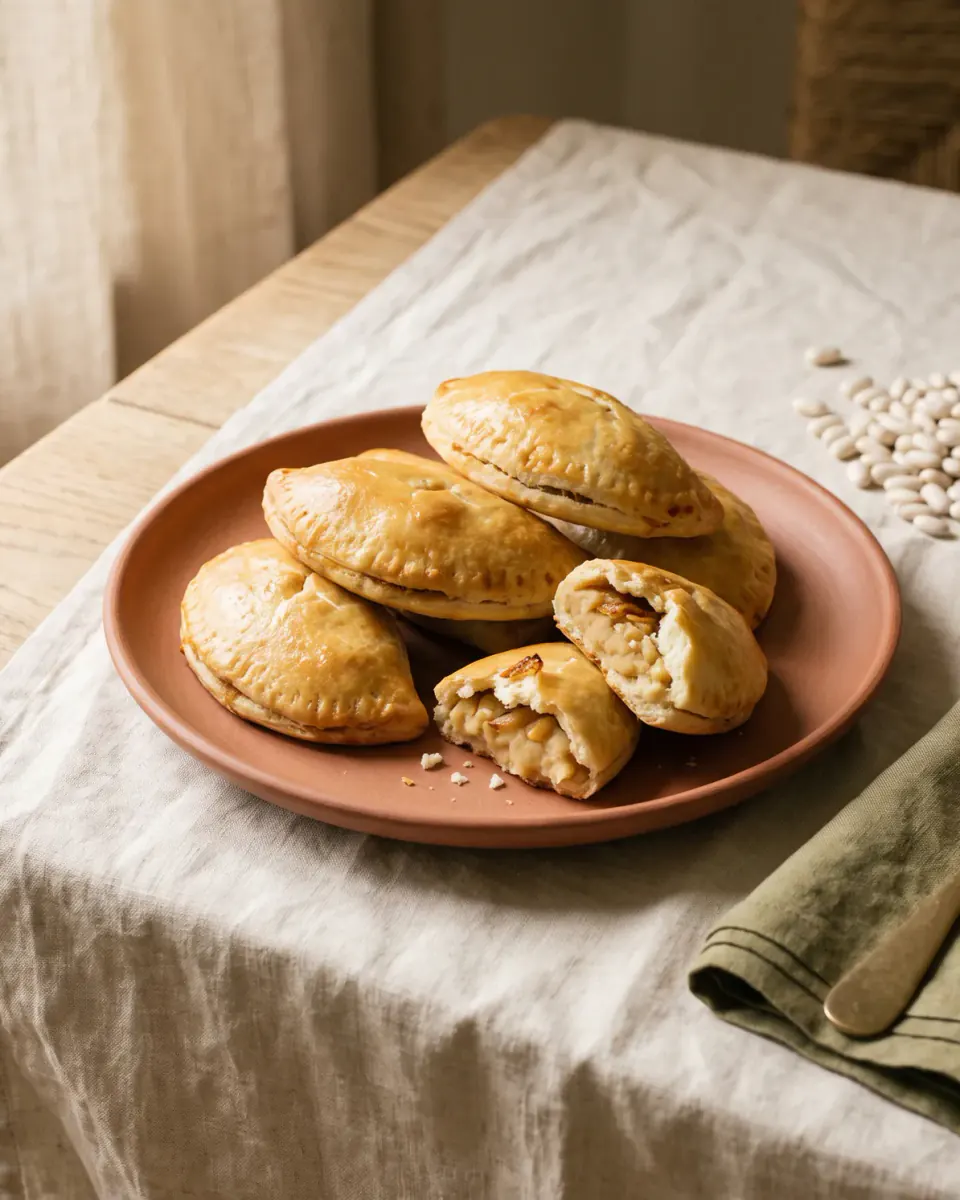
Baked Cabbage Hand Pies
We stew the cabbage low and slow until it turns soft and faintly sweet, then cook off every drop of liquid so the filling never soaks the dough from the inside. The milk-and-egg dough bakes up pillowy, and a quick brush of yolk gives these pies the shiny golden tops everyone reaches for first.

- Prep
- 50 min
- Cook
- 50 min
- Rest
- 1 h 30 min
- Total
- 3 h 10 min
- Servings
- 16
- Level
- Medium
- Per serving
- 200 kcal
Ingredients
For the dough
-
What to use instead
Use 20 g of fresh yeast instead of instant: crumble it into the warm milk with a spoonful of the sugar and wait 10 minutes until it foams.
For the filling
For the glaze
Makes: 16 hand pies
Shopping list
The ingredients for the servings you chose — copy them or send them to a messenger. Tick what you already have at home: only the rest goes on the list.
Method
Oven
190 °C · top and bottom heat, no fan
With a fan: 170 °C
-
Step 1: Make the dough
In a large bowl, combine the flour, yeast, sugar and salt. Add the warm milk, egg and melted butter and knead for 8–10 minutes by hand, or 5–6 minutes with a dough hook. The dough is ready when it is soft and smooth, slightly tacky but peeling cleanly off your fingers.
-
Step 2: Let it rise
Cover the bowl and leave it somewhere warm for about 60 minutes, until doubled in size. Poke it with a floured finger: the dent should fill back in slowly rather than spring back at once.
-
Step 3: Stew the cabbage
Meanwhile, heat the oil in a wide frying pan and soften the onion and carrot for 5 minutes. Add the cabbage and a good pinch of salt, cover and stew over medium heat for 20–25 minutes, stirring now and then. Stir in the tomato paste and pepper, then cook uncovered for another 5 minutes until no liquid is left in the pan.
-
Step 4: Cool the filling
Stir in the dill, tip the cabbage into a bowl and let it cool to room temperature. Warm filling softens the dough and makes the seams split in the oven.
-
Step 5: Divide the dough
Knock the dough back, divide it into 16 pieces of about 55 g each and roll them into smooth balls. Cover with a towel and rest for 10 minutes so the gluten relaxes and the dough stops shrinking back.
-
Step 6: Shape the pies
Flatten each ball into a 10–11 cm round, spoon a heaped tablespoon of filling into the centre and pinch the edges firmly together. Place the pies seam-side down on a parchment-lined baking sheet, 4 cm apart.
-
Step 7: Final proof
Cover the pies with a towel for 20 minutes while the oven heats to 190 °C (375 °F). They will round out visibly and feel light and airy.
-
Step 8: Glaze and bake
Beat the yolk with the milk and brush it gently over the pies. Bake for 20–22 minutes, until the tops are a deep golden brown and the undersides evenly coloured.
-
Step 9: Rest under a towel
Pile the hot pies into a bowl or onto a tray and cover with a clean kitchen towel for 10 minutes. The steam softens the crust and keeps the crumb tender.
Tips & variations
-
Tip
Shred the cabbage as finely as you would for coleslaw. Chunky pieces take longer to soften and poke through the thin dough as you shape it.
-
Variation
Fold 200 g of browned mushrooms into the cabbage for a deeper, almost meaty filling.
-
Swap
Use 20 g of fresh yeast instead of instant: crumble it into the warm milk with a spoonful of the sugar and wait 10 minutes until it foams.
-
Storage
Keep the pies in a sealed bag at room temperature for up to 2 days and warm them at 150 °C for 5 minutes. They also freeze well for up to 2 months.
Nutrition
| 1 serving | Whole dish 16 servings | |
|---|---|---|
| Energy | 200 kcal | 3,200 kcal |
| Protein | 5 g | 80 g |
| Fat | 6 g | 96 g |
| Carbohydrates | 31 g | 496 g |
Approximate values calculated from standard ingredient data.
Cooked it? Rate the recipe
No ratings yet — yours will be the first.