

Sourdough Bread
Sourdough asks for attention more than effort: the dough does most of the work while you fold it a few times and watch it grow. An overnight proof in the fridge brings a gentle tang, and baking in a Dutch oven gives you that crackling crust with a proud ear. This recipe assumes an active wheat starter.
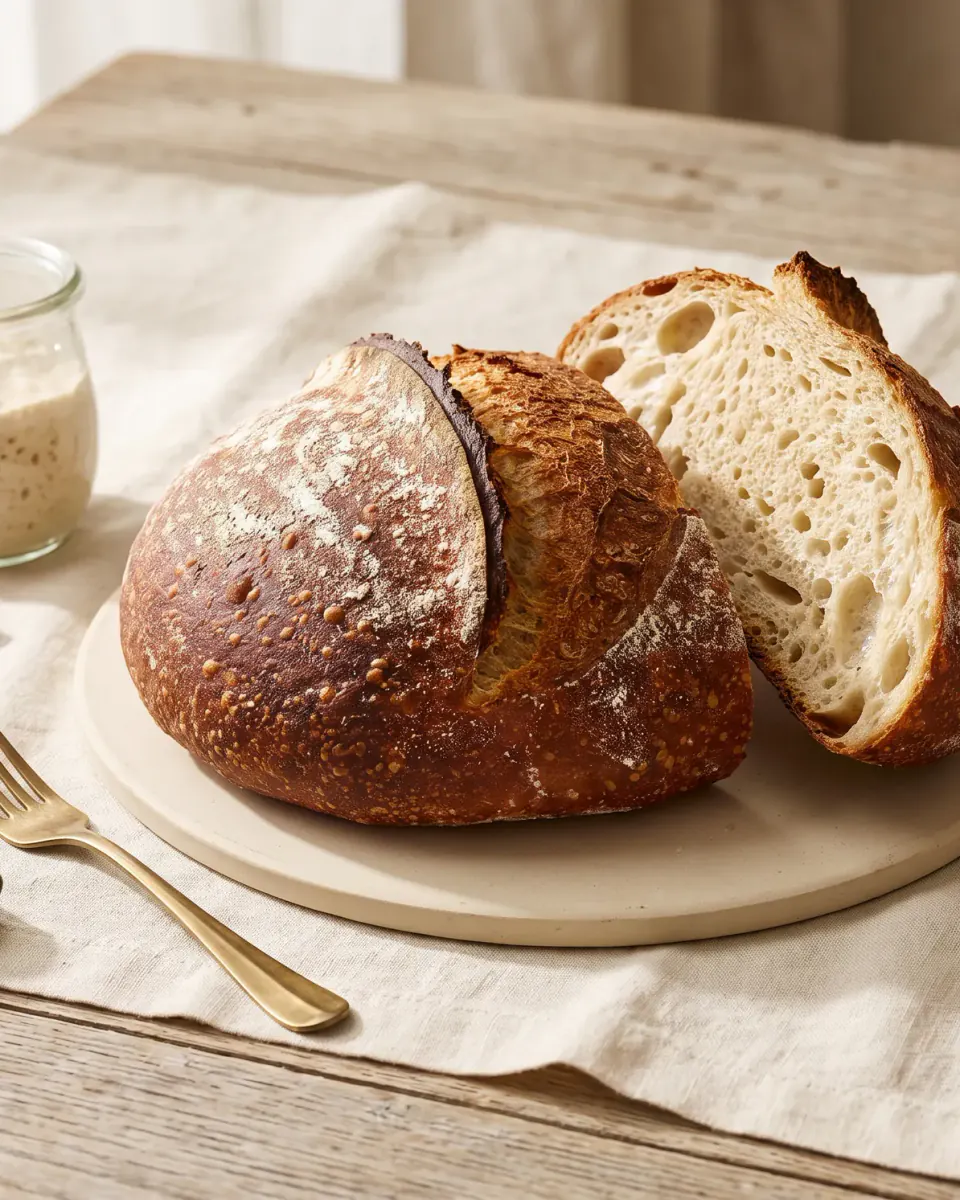
- Prep
- 40 min
- Cook
- 45 min
- Rest
- 24 h 35 min
- Total
- 26 h
- Servings
- 12
- Level
- Challenging
- Per serving
- 165 kcal
Ingredients
Makes: 1 round loaf, about 900 g, 12 slices
Shopping list
The ingredients for the servings you chose — copy them or send them to a messenger. Tick what you already have at home: only the rest goes on the list.
Method
-
Step 1: Feed the starter
Feed your starter 4–6 hours before mixing and keep it somewhere warm. It’s ready when it has at least doubled, looks domed and bubbly, and a spoonful floats in water.
-
Step 2: Autolyse
Mix both flours with the 340 ml of water until no dry bits remain. Cover and leave for 45 minutes; the flour hydrates and the dough gains stretch without any kneading.
-
Step 3: Add starter and salt
Spread the starter over the dough and pinch it in. Sprinkle over the salt, add the remaining 20 ml of water and keep pinching and folding for 3–4 minutes until the water is absorbed and the dough comes back together.
-
Step 4: Bulk ferment with folds
Leave the dough at 24–26 °C (75–79 °F) for 4–5 hours. During the first 2 hours, do a set of folds every 30 minutes: with a wet hand, lift one edge of the dough and fold it over the centre, turning the bowl, 4 times around. It’s ready when it has grown by 50–75%, looks domed, shows bubbles at the sides and jiggles when you shake the bowl.
-
Step 5: Shape the loaf
Turn the dough out, form a loose round and let it rest for 20 minutes. Flour the top, flip it, fold the edges into the centre and drag it across the counter to tighten the surface. Place it seam-side up in a proofing basket well dusted with rice flour.
-
Step 6: Cold proof
Cover the basket with a bag and refrigerate for 12–14 hours, or up to 16. The cold slows fermentation, builds flavour and firms the dough so it’s easy to score.
-
Step 7: Preheat the pot
Put a lidded cast-iron Dutch oven in the oven and heat to 250 °C (480 °F) for at least 45 minutes. Turn the cold dough out onto parchment and make one confident score, 1 cm deep, with the blade held at 30–45°.
-
Step 8: Bake
Lower the loaf on its parchment into the hot pot, cover and bake for 20 minutes. Remove the lid, reduce to 230 °C (445 °F) and bake for another 20–25 minutes, until the crust is deep brown and the inside reads 96–98 °C.
-
Step 9: Cool
Cool on a rack for at least 2 hours. The crust will crackle as it cools and the crumb finishes setting; cut it early and it will be gummy.
Tips & variations
-
Tip
Dough temperature matters more than the clock: at 22 °C bulk fermentation can take 6–7 hours, at 27 °C just 3.5–4. Read the volume and the bubbles.
-
Tip
If your loaf spreads and won’t hold its shape, cut the water by 20–30 ml next time; flours vary a lot.
-
Variation
Fold in 60 g of toasted sunflower seeds or 1 tablespoon of caraway during the first set of folds.
-
Storage
Store cut-side down on a board or in a cloth bag for 3–4 days. Slightly stale slices come back to life in the toaster.
Nutrition
| 1 serving | Whole dish 12 servings | |
|---|---|---|
| Energy | 165 kcal | 1,980 kcal |
| Protein | 6 g | 66 g |
| Fat | 1 g | 10 g |
| Carbohydrates | 34 g | 408 g |
Approximate values calculated from standard ingredient data.
Cooked it? Rate the recipe
No ratings yet — yours will be the first.


