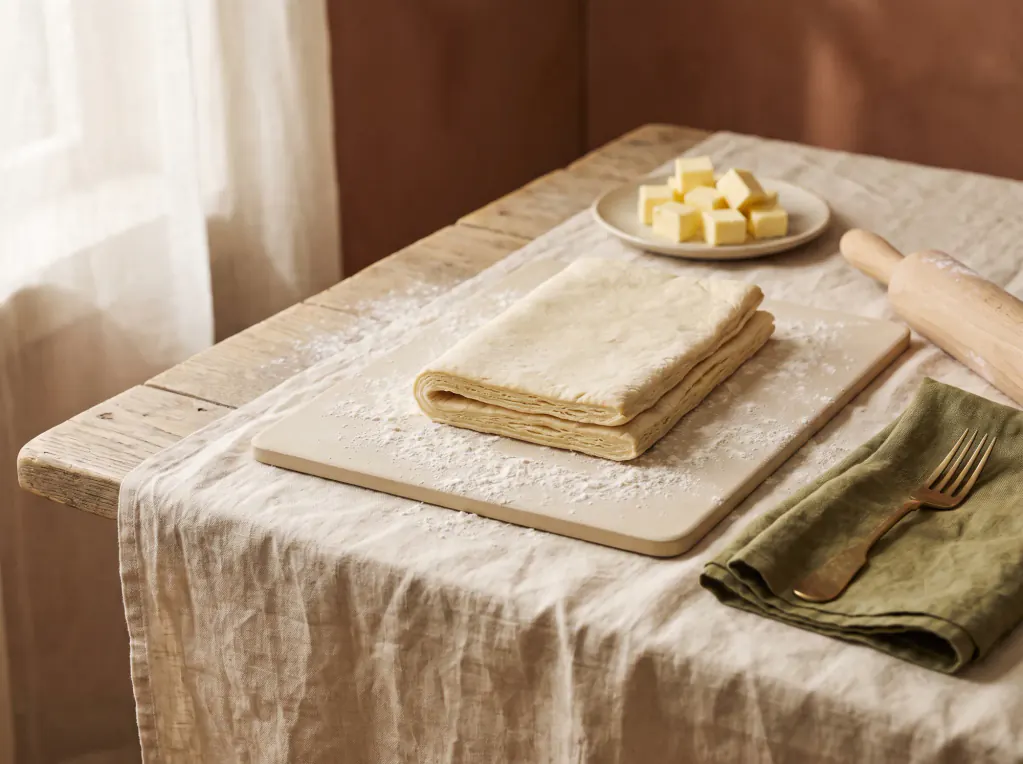
Rough Puff Pastry
Classic puff pastry is built around a separate slab of butter; the rough version simply leaves the butter in chunks and rolls them flat. The layers come out less even, but the mechanism is identical: in the oven the water inside the butter turns to steam and forces the sheets apart. The one condition is that the butter must not melt before it gets there.

- Prep
- 40 min
- Rest
- 2 h 30 min
- Total
- 3 h 10 min
- Servings
- 8
- Level
- Challenging
- Per serving
- 410 kcal
Ingredients
Makes: about 700 g of pastry, enough for 8 portions
Shopping list
The ingredients for the servings you chose — copy them or send them to a messenger. Tick what you already have at home: only the rest goes on the list.
Method
Oven
210 °C · top and bottom heat, no fan
With a fan: 190 °C
-
Step 1: Coat the butter in flour
Mix the flour with the salt and drop in the butter cubes. Toss them so each is dusted with flour, but do not rub them in: the cubes must stay whole.
-
Step 2: Add the water
Pour in the ice water with the lemon juice and bring it together with a spatula into a rough, uneven mass with dry patches and lumps of butter. That is what it should look like.
-
Step 3: Roll a rectangle
On a floured surface roll the dough into a 20×40 cm rectangle. Streaks of butter will smear across the surface — those are your future layers.
-
Step 4: Two folds
Fold the dough in three like a letter, turn it 90° and roll it out again. Repeat once more: two folds in all.
-
Step 5: Chill for 30 minutes
Wrap and refrigerate. The butter warms while you work; chilled again it rolls out in sheets instead of smearing into the dough.
-
Step 6: Two more folds
Repeat the cycle: two more folds with a quarter turn each time, then another 30 minutes in the fridge. That makes four folds altogether.
-
Step 7: Final rest
After the last fold, wrap the block and leave it an hour in the fridge. The gluten relaxes, so the rolled sheet will not pull back on itself.
-
Step 8: Bake it hot
Bake only at 200–210 °C: high heat sets the layers before the butter can run. At 180 °C the butter simply leaks onto the tray and the pastry collapses.
Tips & variations
-
Tip
The moment the butter looks shiny or smears on the worktop, put everything back in the fridge for 20 minutes. Melted butter blends into the dough and there go the layers.
-
Tip
Cut the finished pastry with a sharp knife, straight down. A blunt knife crushes the edge and seals the layers together, and a sealed edge will not rise.
-
Variation
A fifth fold gives finer, more even layers but a tougher pastry. That matters for croissants; for a pie it does not.
-
Storage
Three days in the fridge, three months in the freezer. Defrost in the fridge only: at room temperature the butter melts long before the dough thaws.
Nutrition
| 1 serving | Whole dish 8 servings | |
|---|---|---|
| Energy | 410 kcal | 3,280 kcal |
| Protein | 5 g | 40 g |
| Fat | 29 g | 232 g |
| Carbohydrates | 30 g | 240 g |
Approximate values calculated from standard ingredient data.
Cooked it? Rate the recipe
No ratings yet — yours will be the first.