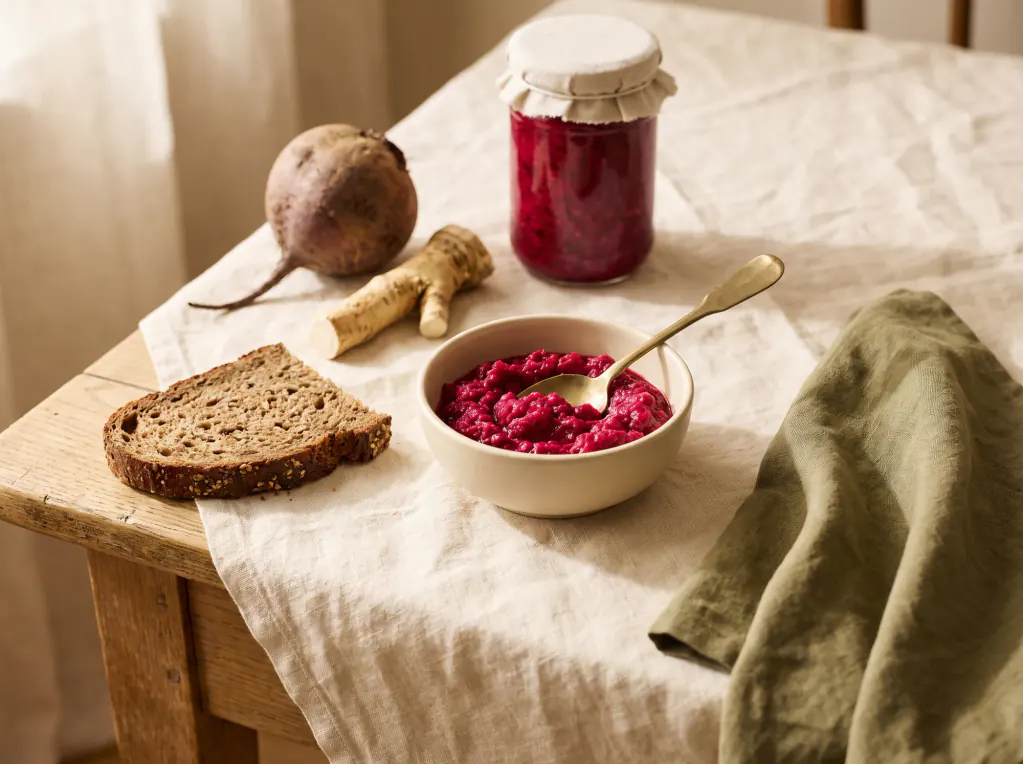
Tomato Adjika
This adjika is built on tomatoes rather than sweet peppers, which makes it thick, dark red and less fiery than the classic. There is more vinegar in it than taste alone would ask for, and that is deliberate: it is what keeps the acidity where a sealed jar can be left in the pantry.

- Prep
- 40 min
- Cook
- 1 h 15 min
- Total
- 1 h 55 min
- Servings
- 24
- Level
- Medium
- Per serving
- 120 kcal
Ingredients
Vegetables
Seasoning
-
What to use instead
Cider vinegar at 6.5% works in place of the 9%: use 390 ml and the amount of pure acid stays the same. Plain 6% vinegar needs 430 ml. Always do the arithmetic — it is the acid that matters here, not the volume.
Makes: 6 half-litre jars
Shopping list
The ingredients for the servings you chose — copy them or send them to a messenger. Tick what you already have at home: only the rest goes on the list.
Method
-
Step 1: Prepare the vegetables
Wash the tomatoes and cut out the stem scars. Seed the peppers, peel the carrots and onions and core the apples. Leave the seeds in the chillies if you like heat, take them out if you do not.
-
Step 2: Mince everything
Put the tomatoes, peppers, carrots, onions and apples through a mincer or blitz them in a blender. Set the garlic and chillies aside for now — they go in at the end, so an hour of boiling does not cook their aroma away.
-
Step 3: Cook down for an hour
Tip the mixture into a heavy 5 l pot, add the oil, sugar and salt, bring to the boil and simmer gently for 45 minutes, stirring up from the bottom every 10 minutes. It is the carrot pulp that catches, and it catches underneath.
-
Step 4: Add garlic, chilli and vinegar
At the 45-minute mark add the crushed garlic and the chopped chillies, pour in all the vinegar and cook for 15 minutes more. The vinegar goes in late on purpose: an hour of boiling drives some of the acetic acid off, and here it is doing a safety job rather than a flavour one.
-
Step 5: Sterilise the jars
While the adjika finishes, wash the jars with soda and heat them in the oven at 120 °C for 15 minutes, or hold them over steam. Boil the lids for 5 minutes. The jars must be hot when the boiling mixture goes in, or the glass will crack.
-
Step 6: Fill and seal
Ladle the boiling adjika into the hot jars, leaving 1.5 cm of headspace, run a knife down the inside to release trapped air, wipe the rims with a clean cloth and seal.
-
Step 7: Water-bath for 15 minutes
Stand the sealed jars on a rack or a cloth in a large pot, cover with water 3 cm above the lids, bring to a full boil and time 15 minutes. This step is not optional fussing: without it the jars are unpasteurised, and that is where home preserves most often go wrong.
-
Step 8: Cool and check
Lift the jars out and leave them on the counter for a day without turning them over. The next morning press the centre of each lid: it should not click. A jar that clicks does not go to the pantry — keep it in the fridge and eat it within a week.
Watch it made
The video comes from YouTube: its cookies start working once you press play.
Tips & variations
-
Tip
The 290 ml of vinegar is not a matter of taste and must not be cut. There are 4 kg of vegetables here, and carrot, onion and garlic are not acidic on their own; the vinegar is what brings the acidity down to where a sealed jar is safe at room temperature. The figure follows NCHFP's tested salsa, about 6 g of pure acid per kilogram of vegetables.
-
Tip
If that much vinegar spoils it for you, do not reduce it — make a fridge adjika instead: cook it the same way, pack it into clean jars, cool it and keep it in the fridge for up to three weeks or the freezer for six months. Cold makes the acidity question go away.
-
Variation
For a thicker adjika, pour off about a cupful of juice after mincing the tomatoes. The cooking time then drops to 35 minutes and the flavour concentrates.
-
Swap
Cider vinegar at 6.5% works in place of the 9%: use 390 ml and the amount of pure acid stays the same. Plain 6% vinegar needs 430 ml. Always do the arithmetic — it is the acid that matters here, not the volume.
-
Storage
Properly sealed and processed, the adjika keeps a year in a dark pantry. Once opened, it lives in the fridge and should be eaten within two weeks. A domed lid, a leak from under it or a sharp smell on opening means the jar goes out without tasting.
Nutrition
| 1 serving | Whole dish 24 servings | |
|---|---|---|
| Energy | 120 kcal | 2,880 kcal |
| Protein | 2 g | 48 g |
| Fat | 5 g | 120 g |
| Carbohydrates | 16 g | 384 g |
Approximate values calculated from standard ingredient data.
Cooked it? Rate the recipe
No ratings yet — yours will be the first.